

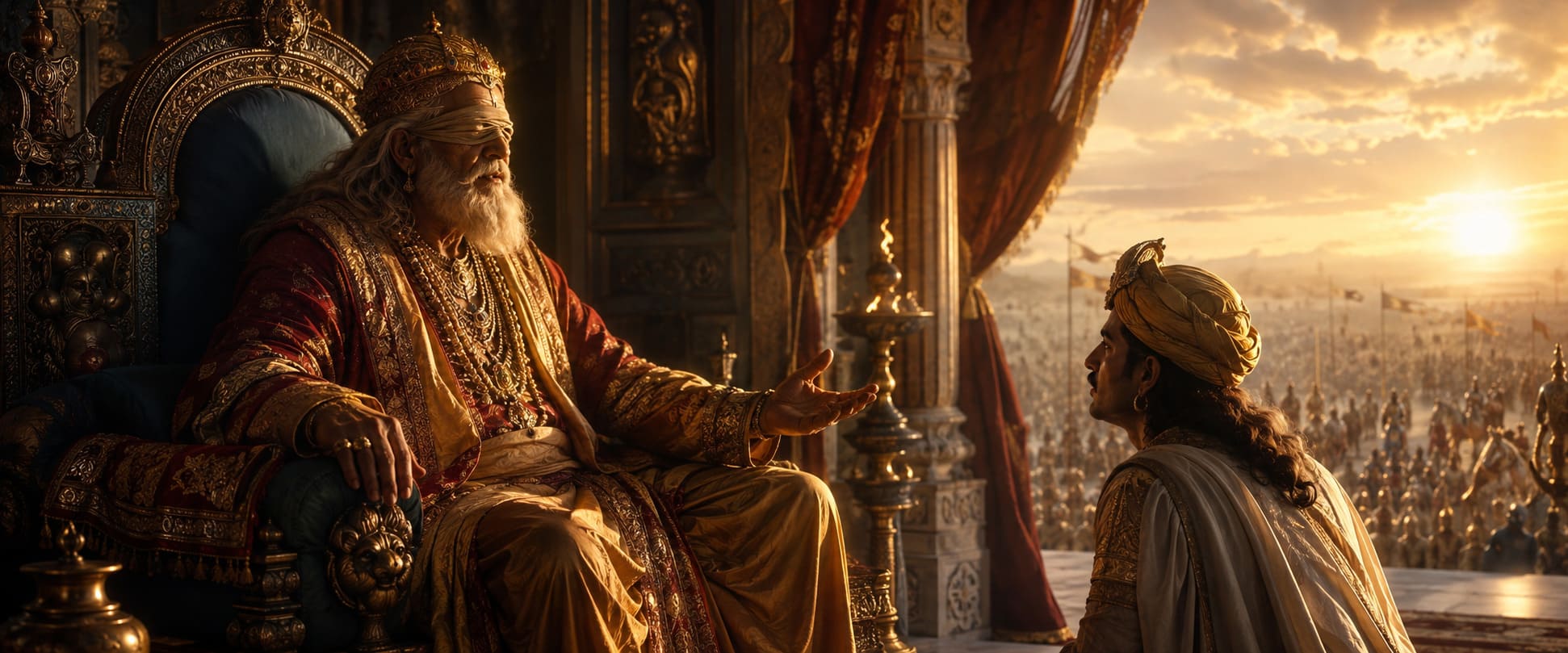
The Yoga of Arjuna’s Despair
ISKCON Title: Observing the Armies on the Battlefield of Kurukṣetra
Divine Form: Shri Parthasarathy – Chennai
The divine form connected with each chapter is my personal devotional interpretation for Verse to Vision. It is not an official classification of the Bhagavad-gītā or ISKCON.
Verse 1
Sanskrit
धृतराष्ट्र उवाच
धर्मक्षेत्रे कुरुक्षेत्रे समवेता युयुत्सवः ।
मामकाः पाण्डवाश्चैव किमकुर्वत सञ्जय ॥ १ ॥
Transliteration
dhṛtarāṣṭra uvāca
dharma-kṣetre kuru-kṣetre
samavetā yuyutsavaḥ
māmakāḥ pāṇḍavāś caiva
kim akurvata sañjaya
English Translation
Dhṛtarāṣṭra said:
“O Sañjaya, after my sons and the sons of Pāṇḍu assembled in the place of pilgrimage at Kurukṣetra, desiring to fight, what did they do?”
—Śrīla Prabhupāda, Bhagavad-gītā As It Is, 1.1
Wisdom Within the Verse
The Bhagavad-gītā begins with King Dhṛtarāṣṭra asking Sañjaya what was happening on the battlefield.
Kurukṣetra was not only a battlefield; it was also a sacred place. Dhṛtarāṣṭra worried that its holy influence would favor the virtuous Pāṇḍavas.
His words reveal his attachment. He calls one side “my sons” and the other “the sons of Pāṇḍu,” even though they all belonged to the same family.
This verse shows how attachment can divide people into “mine” and “theirs.” When personal feelings become stronger than truth, we may stop seeing what is fair and right.
My Reflection
This verse reminds me to look within before judging others.
As an entrepreneur, I may become attached to my ideas, investments or decisions simply because they are mine. But being mine does not make them right. I must be willing to accept the truth and change direction when necessary.
As a leader, I must not divide people into “my people” and “the others.” Kindness should never become favoritism, and loyalty should never replace accountability. Fair rules must apply to everyone.
As a philanthropist, I must remember that service is not about “my foundation,” “my recognition” or “my impact.” The mission is greater than any one person.
Before asking what others are doing, I must ask:
- Am I acting from truth or attachment?
- Am I choosing what is right or protecting what is mine?
- Am I serving the mission or my ego?
Shri Parthasarathy reminds me that Krishna may not remove every difficult situation. Sometimes He stays beside us, holds the reins and gives us the courage to face the truth.
Before I can lead others clearly, I must first remove the blindness within myself.